


What to Do if the Timing Belt Is Torn, and How to Avoid This in the Future
A timing belt (or timing chain) is one of the most critical components in your Audi's engine. It synchronises the rotation of the crankshaft and camshaft, ensuring that the engine's valves open and close at precisely the right moment. When this belt breaks, the consequences can be severe and expensive.
Key Takeaways
| Topic | Key Information |
|---|---|
| Function | Synchronises crankshaft and camshaft rotation for correct valve timing |
| Replacement Interval | Varies by engine; follow the schedule for your exact engine code |
| Failure Cost | Engine damage from a broken belt can exceed R30,000-R50,000 |
| Interference Engines | Most Audi engines are interference type — a broken belt causes valve-piston collision |
| Chain vs Belt | Modern TFSI engines use chains, but these also require monitoring |
What Happens When a Timing Belt Breaks?
Most Audi engines are "interference" engines, meaning the valves and pistons occupy the same space at different times. In an interference engine, the clearance between fully open valves and pistons at top dead centre is essentially zero — the timing mechanism is the only thing preventing contact.
When the timing belt breaks:
- The camshaft stops turning immediately
- Some valves remain open in the combustion chamber
- The pistons continue moving and collide with the open valves
- This causes bent valves, damaged pistons, and potentially a cracked cylinder head
The repair cost for this kind of damage can easily exceed R30,000-R50,000, making prevention far more cost-effective than repair. If the damage is severe, a replacement engine may be more economical than rebuilding.
Warning Signs of a Failing Timing Belt
Watch for these symptoms:
- Ticking noise from the engine — A worn belt may produce a rhythmic ticking sound
- Engine misfires — A stretched belt can cause incorrect valve timing
- Oil leaking near the front of the engine — Can indicate worn timing cover seals
- Engine won't start — In the worst case, a broken belt means the engine won't turn over
Prevention Is Key
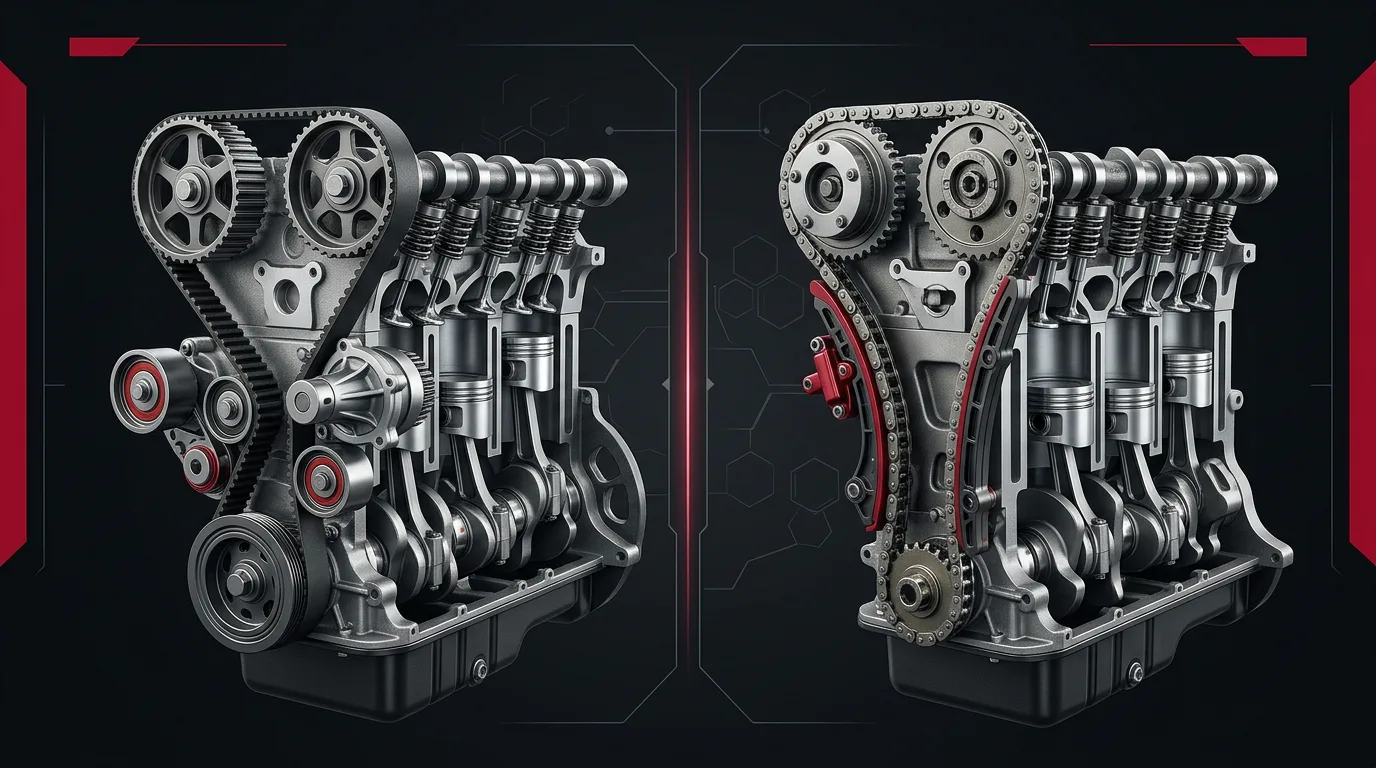
The timing belt is a rubber-toothed belt reinforced with fibreglass cords. Over time, the rubber degrades due to heat and age, and the cords can snap under stress.
- Follow the manufacturer's replacement interval — Belt intervals differ from engine to engine and by model year, so check the service schedule for your exact engine code, and replace the belt early if it is cracked, glazed or oil-soaked.
- Replace the water pump and tensioners at the same time — On engines where the water pump is driven by the timing belt, it takes the same labour to reach, so it makes sense to replace the pump, tensioner and idler rollers together with the belt rather than only the belt.
- Use quality parts — Don't compromise on timing belt quality. OEM or equivalent parts are worth the investment.
Timing Chains vs Timing Belts in Audis
Many modern Audi engines use timing chains instead of belts. While chains typically last longer, they are not maintenance-free. The 2.0 TFSI engine in particular is known for timing chain tensioner failures, especially in early B8 A4 models. The A3 and A5 models sharing this engine are equally affected.
Which Audi Engines Use Belts vs Chains?
Knowing whether your Audi uses a timing belt or chain is essential for maintenance planning:
- Timing Belt: 1.8T (B5/B6 era), 1.9 TDI, 2.0 TDI (PD), 2.5 TDI V6
- Timing Chain: 2.0 TFSI (EA888), 3.0 TFSI, 3.0 TDI (V6), 4.2 FSI V8
If belt or chain failure has already damaged the engine, Audi Parts SA can supply used engines and engine components. Contact us with your engine code for availability and pricing.
Related Reading
- Used Audi Engines for Sale — replacement engines when timing belt failure causes irreparable damage
- All Audi Parts — browse used Audi engine and drivetrain parts
- Understanding Audi's Engine Lineup — learn which engine is in your Audi
- Cleaning Fuel Injectors — another essential engine maintenance task


